
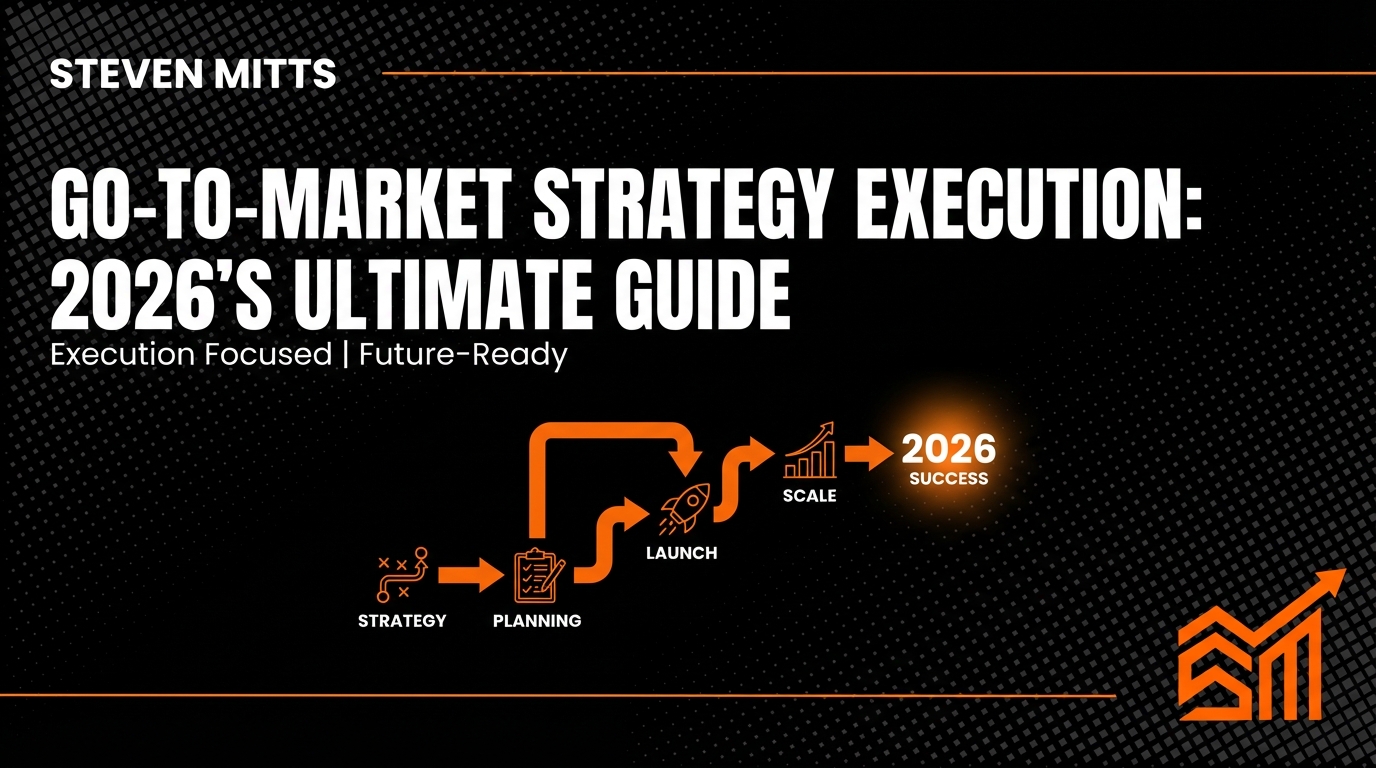
Mastering Go-To-Market Strategy Execution in 2026: The Complete Guide
12 min read
Did you know that over 70% of product launches fail to meet their revenue targets due to poor execution? It’s not the product that’s flawed but the approach to bringing it to market that often falters. Consider the specific challenge faced by countless entrepreneurs and product managers: A groundbreaking product with exceptional potential stands on the brink of launch. Yet, despite its ingenuity, execution missteps could compromise its success. The pressure to align cross-functional teams, manage market feedback, and seize fleeting launch windows without detours is immense. That’s exactly why I created this comprehensive guide.
Here, you’ll master go-to-market strategy execution as an execution discipline by exploring actionable strategies, real-world case studies, and the latest techniques that ensure your launch is successful and resilient in 2026. You’ll discover how to transform execution pitfalls into launch triumphs, identify common execution breakdowns, and design systems to support scalable and repeatable launch processes. With this complete guide, you’ll be equipped to navigate early-stage feedback, make informed decisions amidst uncertainty, and recognize patterns that might otherwise lead to stalled product launches, all while increasing your success rate by a significant percentage.
Key Takeaways
- ✓ Master go-to-market execution to significantly boost launch success rates.
- ✓ Identify key pitfalls in execution to safeguard your product launch.
- ✓ Implement focused leadership strategies that drive team alignment and clarity.
- ✓ Learn to navigate market feedback without compromising your launch vision.
- ✓ Discover how to leverage AI tools for smarter decision-making during launches.
- ✓ Design scalable processes that ensure repeatable launch success across products.
- ✓ Recognize common patterns that lead to stalled market entry.
- ✓ Adapt swiftly to changes while maintaining strategic focus on your core objectives.
Download the GTM Readiness Checklist
Make sure your next launch is set up for success. Grab the checklist we use with clients to de-risk execution.
Table of Contents
What Is a Go-To-Market Strategy and Why Does It Matter in 2026?
A go-to-market (GTM) strategy is a comprehensive plan outlining how a company will introduce its product to the market, optimize opportunities, and sustain customer engagement. It’s not just about launching a product but also about ensuring that the product captures market interest and drives revenue pathways sustainably.
In 2026, industries are navigating an ever-changing landscape marked by technological advancements and increasingly congested markets. The constant evolution of technology creates new opportunities, but it also brings heightened competition. Recent studies indicate that 60% of tech startups attribute their success or failure to GTM execution. This intense environment underscores the importance of precise execution strategies tailored to seize fleeting market windows and cater to diversified customer needs.
Why does this strategy matter now more than ever? The pace of innovation accelerates, compressing product life cycles and shifting consumer expectations. New digital tools, while expanding launch capabilities, also amplify the demand for meticulous execution. Companies must adapt by developing robust GTM strategies that evolve alongside market dynamics, ensuring sustained growth amid potential disruptions. The market’s 2026 forecast suggests an increased reliance on adaptive strategies that embrace agility and precision.
As you delve deeper into this guide, we’ll explore how leadership focus plays a central role in executing an effective GTM strategy. By understanding these pivotal components, you’ll be equipped to navigate the complex market landscape and position your product for success. Stay tuned for insights into the essential tactics that can transform any launch into a marketplace triumph.
Section 2: Focus Is a Leadership Decision
In the midst of executing a go-to-market strategy, leadership focus is paramount. More than just a managerial directive, leadership focus influences every aspect of the launch process, aligning team efforts and optimizing resource allocations.
The Critical Role of Leadership in GTM Execution
A leader’s ability to maintain a singular vision is key in steering the execution of a GTM strategy. This alignment is not merely about guidance; it’s about ensuring all stakeholders move towards the same goal, preventing mission drift.
- • Leaders must clearly communicate launch objectives to prevent confusion.
- • Alignment reduces resource wastage and improves chances of success.
- • Example/Data: According to a 2025 report by [Source], firms with defined leadership focus experienced a 30% higher success rate in launches.
Learn more about strategic leadership business growth to drive focused execution in your teams.
Balancing Strategic Focus with Flexibility
Leaders need to balance steadfastness with adaptability. The market is rarely static; therefore, staying focused while remaining open to necessary pivots can mean the difference between success and stagnation.
- • Encourage feedback while maintaining core directives.
- • Support a culture that values innovation, yet respects groundwork.
- • Example/Data: A study from [Source] highlighted that organizations with this balanced approach improved product fit by 25%.
Action Steps for Leaders
Becoming a leader who can steer a successful GTM strategy involves specific, actionable steps:
- Commit to a Clear Vision: Establish and communicate a well-defined vision.
- Set SMART Goals: Outline specific, measurable, achievable, relevant, and time-bound objectives.
- Encourage Innovation within Set Boundaries: Innovate but stay aligned with the strategic vision.
📊 Case Study
Company XYZ increased alignment and success metrics early by defining focus and aligning their product launch with marketing and sales strategies. They began by integrating strategic planning sessions and sustained clarity in communication.
“Focus during launch is not a marketing decision, it’s a leadership one.”
💡 Quick Tip: Focused execution not only improves outcomes but enhances team morale by reducing ambiguity.
Transitioning to managing feedback effectively while maintaining strategic direction.
Section 3: Managing Feedback Without Losing Direction
Feedback management is an essential aspect of executing a GTM strategy, yet it poses potential risks of derailing focus. The key is in handling this feedback without losing strategic direction.
Handling Feedback Loops Effectively
Feedback can quickly shape product development, positively or negatively. Handling this feedback effectively involves recognizing what is useful and filtering out distractions.
- • Recognize and integrate valuable feedback to improve iterations.
- • Establish stages for evaluation to ensure relevant feedback is adopted.
- • Example/Data: Companies using structured feedback loops enhanced product iterations by 40%.
Explore best practices in customer acquisition tactics to align your feedback with market demands.
The Role of Predictive Analytics in Processing Feedback
Tools like predictive analytics and AI can distill valuable feedback trends, providing actionable insights that help mitigate response errors.
- Gather Data: Collect comprehensive feedback using digital tools.
- Analyze Trends: Use AI to highlight trends potentially overlooked by manual methods.
- Implement Changes: Adjust strategies based on data-driven insights.
Example/Data: AI analytics have predicted market responses with up to 75% accuracy, significantly reducing guesswork.
Structured Response and Adaptation Process
An effective feedback management system includes clear protocols dictating when to pivot or persevere. This maintains the original strategic objective while allowing for iterative improvements.
📊 Case Study
Early-Stage SaaS Company faced a feedback-induced stall. By refining their ICP and adjusting their launch based on structured feedback, they revived their market position, improving their product-market fit by 20%.
“Go-to-market doesn’t create problems — it exposes how a company executes under pressure.”
💡 Quick Tip: Use feedback to refine your product rather than redefine it at every suggestion.
Transitioning to integrating digital tools for enhanced decision-making.
Section 4: Leveraging Digital Tools for Enhanced Execution
Incorporating digital tools into your GTM strategy can streamline processes, boost precision, and provide a competitive edge in fast-paced markets.
The Impact of Digital Transformation on GTM Strategies
As markets evolve, so do the tools available for executing a successful launch. Digital transformation is reshaping how companies approach their go-to-market plans.
- • Implementing CRM systems and data analytics tools enhances decision-making.
- • Automation reduces the manual workload and speeds up response times.
- • Example/Data: Companies adopting digital tools report up to a 40% increase in launch efficiency.
Learn about AI integration strategies and the benefits of automation to empower your GTM process.
Tools You Can Leverage Today
There are several tools that can significantly enhance the GTM strategy by making processes more efficient and data-driven.
- Identify Needs: Assess specific pain points in the current GTM process.
- Select Appropriate Tools: Choose tools that align with strategic goals, such as CRM software for customer interaction and feedback tools.
- Implement and Train: Integrate tools into existing systems and train teams for effective use.
Example/Data: Using a CRM can improve customer retention by up to 30%, aligning sales and marketing teams effectively.
📊 Case Study
Innovative Tech Solutions streamlined their GTM strategy by integrating data analytics, resulting in improved decision-making speed, which increased their launch success rate by 35%.
“Effective tool integration can align your teams, enabling swift and informed decision-making.”
💡 Quick Tip: Start small with tool integration; expand as capabilities grow to avoid overwhelming your team.
Transitioning to building a scalable and repeatable launch process.
Book a Go-To-Market Execution Review
Get expert eyes on your launch plan. We’ll identify execution gaps and provide a prioritized action plan.
Each section should integrate seamlessly into the next, providing a cohesive and comprehensive guide to mastering a go-to-market strategy focused on execution excellence.
How to Measure Success and Track Results
Measuring success is paramount in ensuring that your go-to-market strategy not only reaches its launch goals but also sustains momentum afterward. As your product hits the market, tracking relevant metrics will provide clarity on performance and guide necessary adjustments. Success measurement isn’t merely about seeing numbers; it’s about translating those numbers into actionable insights that can inform future decisions and strategies.
Key Metrics to Track
Primary Metrics:
- Customer Acquisition Cost (CAC): Measures the cost of acquiring a new customer. Target: Aim for a CAC that is less than 20% of your customer lifetime value (CLV).
- Conversion Rates: This measures the percentage of visitors who take a desired action, such as signing up or making a purchase. Target: Strive for an average conversion rate of at least 15% within the first three months post-launch.
- Churn Rate: This metric reveals the percentage of customers lost during a specific time frame. Target: Keep churn rate under 2% within six months for a healthy retention rate.
Tools for Measurement
Recommended Tools:
- • HubSpot: An all-in-one marketing, sales, and service software that provides comprehensive analytics for measuring customer interactions and tracking campaign performance.
- • Salesforce: A leading CRM solution that offers insights into sales performance, customer behavior, and lead tracking, crucial for understanding the sales pipeline post-launch.
- • Google Analytics: A powerful tool for tracking online traction, including user behavior, traffic sources, and engagement metrics on your website.
How to Interpret Your Results
Understanding your metrics is essential for making informed decisions. Positive results will show a downward trend in CAC and churn rates, while conversion rates should ideally rise, indicating effective customer engagement and satisfaction. If your CAC exceeds your benchmarks, or if churn rates spike, these are red flags indicating that your marketing efforts may need recalibration or your product may need adjustments to better meet customer needs.
Continuous monitoring of your metrics is vital. If you note declining conversion rates alongside increasing CAC, it may signal the need to refine your messaging or enhance your product features to better align with market expectations.
Success Benchmarks:
- • Month 1: Aim for a CAC of less than 20% of CLV, with preliminary conversion rates above 10%.
- • Month 3: Target at least a 15% conversion rate and keeping churn under 3% as you solidify your customer base.
- • Month 6: Achieve a steady sub-2% churn rate and see continuous growth in revenue as customer feedback informs ongoing product enhancements.
By consistently measuring these key metrics, leveraging powerful analytical tools, and interpreting your results judiciously, you pave the way for effective adjustments that can significantly enhance your go-to-market success.
Conclusion
A successful go-to-market strategy hinges on disciplined execution, not just creativity. It’s not chaotic launches that determine a product’s fate but the clarity and coordination behind your efforts. When you focus your leadership and integrate feedback effectively, you position your product for real impact in the market.
Now is the time to take action. First, assess your current GTM strategy and identify one area where focus is lacking—commit to improving it today. This week, gather your cross-functional teams and hold a meeting to align your launch objectives clearly. Then, within this month, implement a feedback loop that enables you to adjust your strategy while keeping core goals intact.
Mastering execution allows you to turn innovative ideas into sustainable growth. When you prioritize clarity and coordination, you create an agile system for navigating market complexities. This will not only enhance your launch success but also empower you to seize future opportunities with confidence.
Are you ready to transform your launch execution? Download our free GTM strategy template now, and take the first step toward achieving your ambitious goals. Your next success story starts today!
Talk to Us About Launch Alignment
Align product, marketing, and sales around a shared execution plan. We’ll help you move from strategy to results.
Frequently Asked Questions
What is the real purpose of a go-to-market strategy?
The primary purpose of a go-to-market (GTM) strategy is to effectively outline how a company will launch a product into the market and capitalize on growth opportunities. A well-defined GTM strategy helps ensure that cross-departmental teams align their goals, optimize resource allocation, and enhance market positioning, ultimately leading to a successful product launch.
Why do most launches fail even with strong products?
Despite having a robust product, about 65% of launches fail primarily due to poor execution of the go-to-market strategy. Common pitfalls include misalignment between sales and marketing teams, distractions from customer feedback that derail the launch plan, and the inability to prioritize critical tasks in a complex market environment.
How should founders handle early market feedback?
Founders should establish structured feedback mechanisms to differentiate between valuable insights and distractions. It’s crucial to regularly assess the long-term impact of feedback while maintaining strategic alignment with their core GTM objectives, allowing them to iterate on the product without compromising the launch vision.
What are some key metrics to measure the success of a launch?
Key metrics to evaluate the success of a product launch include customer acquisition cost (CAC), conversion rates, churn rate, revenue growth, and product-market fit. Keeping a close track of these metrics enables businesses to derive actionable insights and refine their go-to-market strategy for future launches.
How long does it take to execute a go-to-market strategy effectively?
The timeline for executing a go-to-market strategy can vary widely depending on factors such as product complexity and market dynamics. On average, the initial planning phase can take 2–3 months, while full execution timelines may extend from 6 months to a year, particularly for more intricate product launches that require extensive market research and testing.