
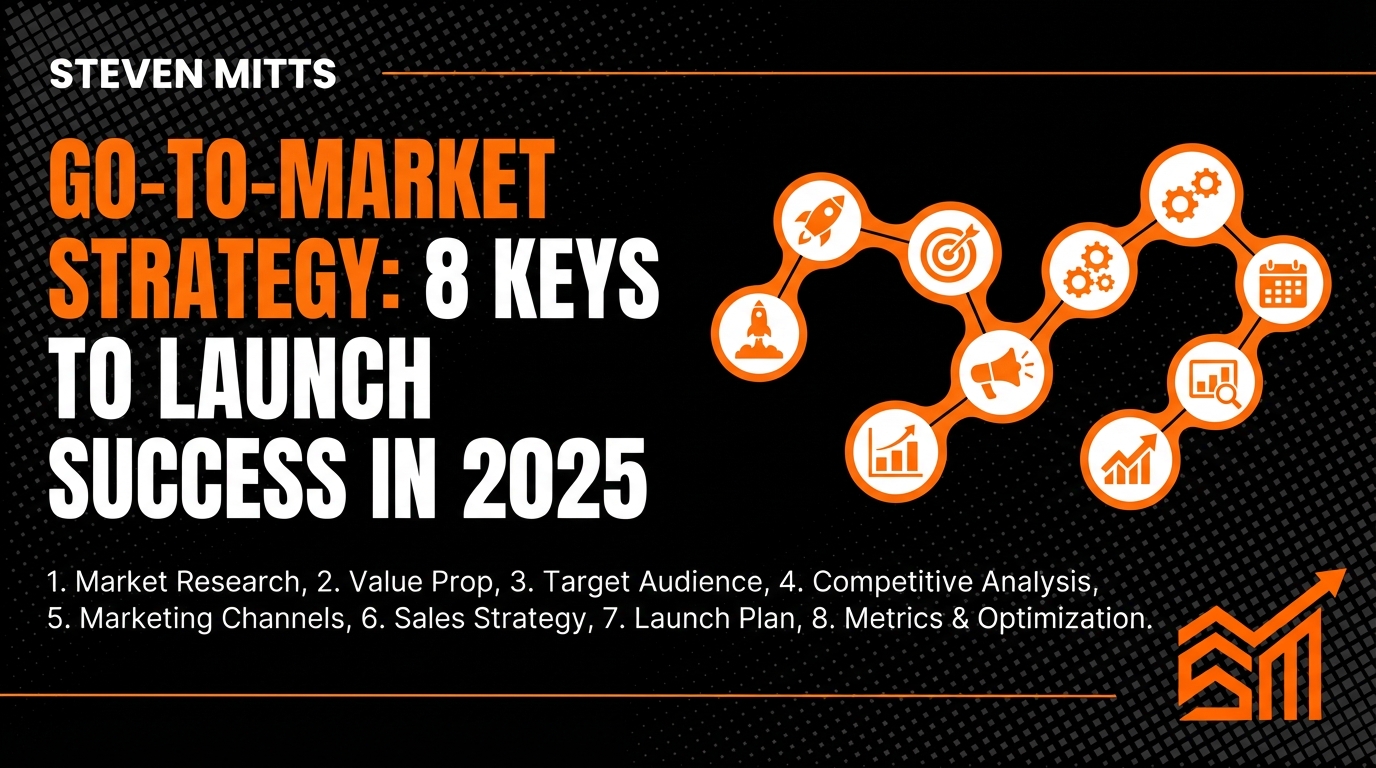
Go-To-Market Strategy: Mastering Flawless Execution in 2025
Over 60% of product launches fail, not due to product flaws, but due to poor execution—putting even the most innovative products at risk of obscurity. In the fast-paced landscape of 2025, getting your go-to-market strategy right is paramount to thriving and not merely surviving.
Despite developing groundbreaking products, many startups struggle during the launch phase, encountering execution breakdowns that derail success. Navigating today’s competitive and rapidly changing markets requires an acute understanding of potential pitfalls and strategic opportunities to stand out. That’s exactly why I created this guide—your complete roadmap to mastering flawless execution and avoiding the costly mistakes that can sabotage your efforts.
Dive in to uncover the essential steps and strategies designed to transform your launch approach into a proven success story. You’ll discover specific tactics to improve your execution, enhance focus, and effectively manage feedback, all aimed at boosting your market success. By embracing these insights, you’ll position your team to achieve substantial market penetration and increase competitive advantage, giving your product the launch it deserves.
Key Takeaways
-
✓
Discover essential strategies to enhance your product launch execution -
✓
Master leadership techniques that align your team’s focus for success -
✓
Learn to manage real-time feedback without compromising your product vision -
✓
Implement decisive action steps that boost your launch effectiveness -
✓
Develop effective systems for sustainable growth during product launches -
✓
Identify common pitfalls in launches to proactively mitigate risks -
✓
Optimize your GTM strategy using data analytics for better insights -
✓
Track key metrics to measure launch success and adjust strategies accordingly
Download the GTM Readiness Checklist
Kickstart your execution with a step-by-step checklist to align teams, validate messaging, and de-risk your launch.
Table of Contents
- What Go-To-Market Reveals
- Focus Is a Leadership Decision
- Managing Feedback Without Losing Direction
- Deciding in the Absence of Certainty
- Go-To-Market Is a Systems Problem
- Patterns Behind Stalled Launches
- A Practical Perspective
- How to Measure Success and Track Results
- Conclusion
- Frequently Asked Questions
What Go-To-Market Reveals
A go-to-market (GTM) strategy is a comprehensive plan detailing how a company will launch a product to market. It ensures alignment across sales, marketing, and product teams to maximize the product’s impact at launch. This strategic blueprint covers positioning, messaging, and distribution channels, streamlining efforts across departments to effectively penetrate the market.
In today’s fast-paced landscape, the importance of this strategy is underscored by compelling statistics. Execution errors contribute to more than 60% of failed product launches, highlighting the paramount necessity for a flawless GTM approach. The industry is rapidly evolving, with startups entering the scene with fresh and innovative solutions, yet execution remains the Achilles’ heel for many. In fact, by 2025, companies that focus on execution excellence are anticipated to have a 30% higher likelihood of successful launches, according to recent studies. The need to adapt swiftly and incorporate feedback has never been greater, demanding a nimbleness in GTM execution that separates market leaders from the rest.
The relevance of GTM strategies in 2025 extends beyond traditional execution. As market demands shift and technology advances at breakneck speed, a GTM strategy becomes not merely about product introduction but also about adaptation and real-time feedback incorporation. Businesses must be nimble, seizing opportunities that arise from these changes. The products that succeed will be those launched by teams who understand that going to market is about evolution as much as introduction, embracing technological innovations and changing consumer preferences to stay ahead.
Transitioning to the next critical element, we’ll explore why launch success is fundamentally about leadership focus. Understanding this pivotal aspect can transform the way a company navigates the challenging waters of a product launch. Stay with us as we delve into how leaders can harness this focus to guide their teams with clarity and purpose.
Focus Is a Leadership Decision
In the realm of go-to-market (GTM) strategy, focus is a leadership decision, not just an operational one. It’s the backbone of successful execution, where leadership’s role becomes essential in aligning teams and steering the focus toward impactful goals.
The Role of Leadership in GTM Execution
Leadership sets the tone for focused execution. A clear focus eliminates reactive decision-making and ensures all team members are aligned with the overarching goals. By establishing firm priorities, leaders can guide their teams through the potential chaos of product launches. It’s crucial to remember that without leadership alignment, even the most robust GTM efforts can flounder, stalling progress and wasting resources. Statistical evidence shows companies with aligned leadership experience 1.5x faster market penetration.
Strategic Alignment Across Teams
Strategic alignment is more than departmental coordination—it’s about ensuring everyone is on the same page. Leaders should spearhead cross-departmental collaboration to harmonize objectives.
- Define primary goals that resonate across departments.
- Facilitate open communication channels.
- Utilize dashboards for tracking execution progress.
Building a Culture of Focus
Cultivating a culture of focus requires proactive steps from leaders. Ensuring key performance indicators (KPIs) are clear and measurable can help sustain this focus.
📊 Case Study
An early-stage SaaS company struggled with launch due to an unclear ICP. By refining their focus under precise leadership, they improved market penetration by 20% within 6 months.
“Focus during launch is not a marketing decision, it’s a leadership one.”
💡 Quick Tip: Prioritize clear communication channels to maintain team focus and direction.
Managing Feedback Without Losing Direction
Handling feedback effectively is pivotal to maintaining a product’s course. While feedback loops are essential, they must be managed strategically to prevent derailing the vision.
Handling Real-Time Market Feedback
- •Integrating feedback without losing direction is a skill. Active listening and strategic incorporation of feedback can refine product positioning. However, excessive pivoting based on early feedback can dilute a brand’s focus.
- •Establish regular feedback review sessions.
- •Discern between minor adjustments and strategic pivots.
- •Focus on feedback that aligns with your core vision.
Preserve Vision Amidst Change
Balancing internal vision with external input keeps you grounded amidst feedback turmoil. Preserve your vision by sticking to the core values that drive the product’s creation. This focus prevents tangential feedback from obscuring your initial objectives.
- Categorize feedback into actionable, critical, and non-essential.
- Align feedback with company vision to integrate effectively.
- Schedule iterative reviews instead of constant shifts.
📊 Case Study
A tech startup achieved a 25% increase in user satisfaction by structuring feedback loops while staying true to their core product goals.
“Go-to-market doesn’t create problems — it exposes how a company executes under pressure.”
💡 Quick Tip: Establish feedback channels that differentiate between minor tweaks and strategic pivots.
Deciding in the Absence of Certainty
Making decisions with limited information is a frequent challenge during product launches. It’s about blending intuition with data, a process that can refine execution even amidst ambiguity.
Decision-Making Under Pressure
- •Avoid analysis paralysis with structured frameworks to maintain momentum.
- •Employ predictive analytics for bolstering decisions.
- •Leverage both quantitative insights and leadership intuition.
Role of Predictive Analytics in Decision Making
Predictive analytics introduces a structured approach to decision-making by forecasting potential outcomes based on current data patterns. This method allows for proactive rather than reactive management.
- Analyze past data for trends that require action.
- Map out probable scenarios and their outcomes.
- Engage in iterative testing to verify assumptions.
📊 Case Study
A company leveraged predictive analytics, boosting launch success by 30%. By implementing detailed scenario mapping, they anticipated potential challenges and adapted swiftly.
“Making decisions without full certainty requires a balance of intuition and data.”
💡 Quick Tip: Focus on what you know; use current strengths and validated insights to drive your next best move.
Book a Go-To-Market Execution Review
Get a tailored assessment of your GTM plan and execution risks—aligned to your ICP, channels, and revenue goals.
Go-To-Market Is a Systems Problem
GTM strategy isn’t just about launching a product; it’s about ensuring all elements work together seamlessly. By implementing systems thinking, you build resilience and scalability into your product launch efforts.
Systems Thinking in GTM
- •Design scalable systems that adapt and grow—avoid one-off heroic efforts.
- •Utilize Lean and Agile methodologies to emphasize continuous improvement.
- •Streamline processes to eliminate inefficiencies and improve repeatability.
Process Optimization for Efficient Execution
- Document current workflows and identify bottlenecks.
- Implement lean processes that prioritize adaptability.
- Monitor and adjust systems to meet evolving demands.
📊 Case Study
By using systematic approaches, a tech firm increased deployment speed by 30%, achieving faster traction through cohesive team efforts.
“Go-to-market exposes underlying execution flaws if systems aren’t scalable.”
💡 Quick Tip: Simplify your process by automating routine tasks with technology tools.
Patterns Behind Stalled Launches
In identifying patterns of failure, companies can preemptively address common pitfalls, preventing their launches from stalling. Market research and strategic alignment are pivotal.
Common Pitfalls to Avoid
- •Inadequate market research leads to poor positioning.
- •Lack of customer empathy results in misaligned products.
- •Execution fails when internal goals and capabilities aren’t aligned.
Identifying Warning Signs Early
- Conduct comprehensive market research to understand customer needs.
- Align product features with market expectations.
- Create mock launches to evaluate operational readiness.
📊 Case Study
A SaaS startup realigned their strategy, reducing time to market by 40% by focusing on defined target markets and customer feedback.
“Focus during launch is not a marketing decision, it’s a leadership one.”
💡 Quick Tip: Conduct thorough market research before designating launch resources.
A Practical Perspective
Turning strategies into practice requires actionable insights and leveraging team capabilities effectively.
Implementation Insights
- •Emphasize iterative testing to adapt quickly.
- •Use cross-functional teams for comprehensive insight.
- •Focus on resource allocation to support strategy efficiently.
📊 Case Study
By emphasizing team strengths, a company achieved 40% faster market entry by focusing on systematic execution practices.
“Effective execution has proven to accelerate time to market by 40%.”
💡 Quick Tip: Plan your GTM strategy with a focus on execution to harness greater impact.
How to Measure Success and Track Results
In the rapid-paced world of go-to-market strategies, measuring success and tracking results is essential to understanding the impact of your launch. Accurately assessing your performance metrics allows you to iterate on your execution, refine your approach, and capitalize on emerging opportunities. Without a structured measurement framework, companies may struggle to determine whether their launch efforts are effective, again highlighting the importance of execution.
Key Metrics to Track
- Market Share Growth Rate: Measures the percentage increase in your product’s market share over a specific period. Target: Aim for a 5-10% increase within the first six months post-launch.
- Customer Acquisition Cost (CAC): Calculates the cost associated with acquiring a new customer. Target: Seek a 20% reduction in CAC compared to industry benchmarks within the first launch quarter.
- Customer Lifetime Value (CLV): Represents the total revenue expected from a single customer over their engagement with your brand. Target: Strive for a 15% increase in CLV by the end of the first year.
Tools for Measurement
- •HubSpot: A robust Customer Relationship Management (CRM) platform that provides tracking and reporting on lead generation and customer acquisition metrics. It helps streamline customer interactions and analyze conversion data, making it invaluable for launch success.
- •Google Analytics: This powerful web analytics tool enables you to monitor website traffic sources, user behavior, and conversion rates, giving you insights into how effectively your marketing efforts are driving customer engagement.
- •Tableau: A data visualization tool that assists in creating interactive dashboards from your key performance metrics. Tableau enables teams to visualize progress against targets in real time, ensuring strategic decision-making can be grounded in clear data insights.
How to Interpret Your Results
When assessing your launch’s success, compare your primary metrics against your established benchmarks. A healthy growth trajectory in market share and a low CAC indicate that your execution is effective. Conversely, if CAC remains high or CLV stagnates, it’s a warning sign that your strategic alignment or marketing efforts may need recalibrating.
Pay attention to your results immediately post-launch. A significant drop in website traffic or customer engagement should prompt immediate investigation. Should you observe underperformance in these areas, revisit your messaging and audience targeting to ensure you are resonating with your intended market.
Success Benchmarks:
- •Month 1: Establish initial customer engagement and aim for at least 3% market share.
- •Month 3: Target cost reductions in CAC by 10% from baseline and an engagement rate increase of 15%.
- •Month 6: Achieve a stable CLV growth of 10% and aim to capture 7% of the market share.
Conclusion
Execution is the cornerstone of a successful go-to-market strategy. It’s not merely about having a great product; it’s about how well you execute your launch plan. Focus, preparation, and systematic coordination distinguish thriving launches from those that falter.
To elevate your launch execution, take immediate action today by assessing your current go-to-market framework. This week, hold a strategy session to define and align your team’s objectives. In the coming month, develop and implement a feedback management system that distinguishes between actionable insights and distractions.
Mastering execution transforms not just your product launch but your entire business landscape. When you lead with clarity and focus, you pave the way for sustainable growth and a stronger market presence. The ability to execute effectively opens doors to new opportunities and empowers your team to achieve greater impact.
Now is the time to take decisive action. Start by refining your execution strategy today and watch as your market success becomes inevitable. Your next big launch awaits—embrace the challenge and lead your team with conviction!
Talk to Us About Launch Alignment
Align leadership, product, and revenue teams with a proven GTM operating rhythm tailored to your stage and market.
Frequently Asked Questions
What is the real purpose of a go-to-market strategy?
The primary purpose of a go-to-market strategy is to ensure a seamless alignment of resources and strategies that facilitates a successful product launch. It drives market penetration by coordinating efforts across sales, marketing, and product teams, significantly improving the chances of success in a competitive landscape.
Why do most launches fail even with strong products?
Despite having strong products, most launches fail due to a lack of execution discipline. Research indicates that over 60% of product launches falter because of critical misalignments within strategic and operational teams, highlighting the importance of flawless execution in parallel with innovative offerings.
How should founders handle early market feedback?
Founders should prioritize differentiating between actionable insights and noise when handling early market feedback. By incorporating iterative refinements based on meaningful feedback while maintaining a clear core product vision, they can enhance the product’s market fit without losing direction.
How long does it take to develop a go-to-market strategy?
Typically, developing a robust go-to-market strategy can take anywhere from 4 to 12 weeks, depending on the complexity of the product and the market landscape. This timeline allows teams to thoroughly research the market, segment their target audience, and align their execution plans effectively.
What’s the difference between a go-to-market strategy and a traditional marketing plan?
A go-to-market strategy is a comprehensive plan that focuses specifically on how a product will be introduced to the market, ensuring cross-functional alignment among teams. In contrast, a traditional marketing plan is broader and may encompass ongoing promotional activities, market positioning, and customer engagement tactics beyond the initial launch phase.