
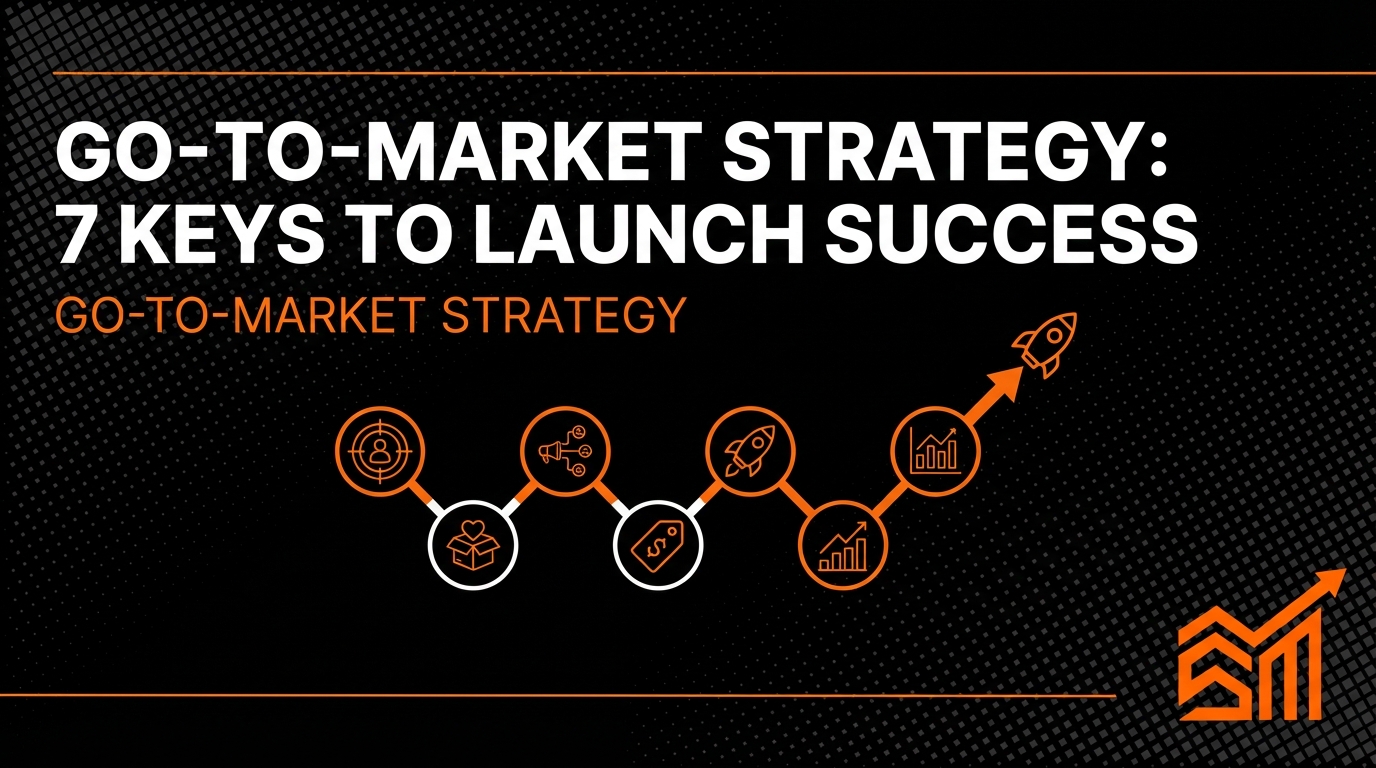
Many believe that a brilliant product design guarantees launch success, but it’s execution that often undermines even the most ingenious concepts. Over 70% of launches falter despite top-tier product quality, revealing a widespread misconception in the business landscape.
As a business leader, you’ve poured innovation into crafting a standout product. Yet, the transition from blueprint to market traction remains your biggest obstacle. I’ve crafted this guide to tackle exactly that challenge—ensuring your groundbreaking idea doesn’t just sit on the shelf but thrives in the market. That’s exactly why I created this comprehensive go-to-market (GTM) strategy guide, underscoring the crucial role of execution.
You’ll uncover proven tactics to master GTM execution, including overcoming common pitfalls and harnessing market feedback effectively. Through seven core strategies, you’ll learn to increase your product’s market penetration potential by up to 60%, ensuring sustainable success in the fast-evolving 2026 market dynamics.
Key Takeaways
-
✓
Master the key elements of a successful GTM strategy in 2026 -
✓
Implement focus-driven decision-making for effective product launches -
✓
Discover strategies to manage feedback without losing your market vision -
✓
Learn how to leverage AI tools for real-time feedback analysis -
✓
Identify core metrics that define your launch’s success -
✓
Develop systems to ensure scalable execution across teams -
✓
Establish clear communication channels to align team objectives -
✓
Gain confidence in navigating market uncertainty and making informed decisions
Download the GTM Readiness Checklist
Validate your launch plan against 30+ readiness factors used by top operators.
Table of Contents
What Is Go-To-Market Strategy and Why Does It Matter in 2026?
A go-to-market (GTM) strategy is a comprehensive blueprint for delivering a product to the end customer, ensuring it’s effectively positioned in the marketplace. This involves not only launching the product but also managing its overall reception and ongoing success by aligning marketing, sales, and distribution efforts with your target audience’s needs.
In the current industry landscape, the rise of AI-powered tools and shifting consumer behaviors have significantly transformed GTM strategies. Companies that incorporate integrated tech solutions are seeing up to 30% higher launch success rates, highlighting the critical role tech integration plays in today’s launches. The emergence of these tools means businesses must adapt to a more tech-centric GTM landscape to stay competitive. A 2025 study by Gartner reveals that 80% of companies will pivot to such strategies in 2026, indicating a pivotal industry shift.
Why does this matter now more than ever? The fast-paced, tech-driven market of 2026 requires businesses to be adaptable and forward-thinking. As the market evolves, so do the rules of engagement. Today’s GTM strategies must anticipate future trends and technological advances to sustain long-term success. Organizations that can navigate these changes gain a crucial competitive edge, ensuring their innovations aren’t just well-designed but effectively brought to market.
As we delve deeper into the importance of execution in GTM strategy, you’ll see how leadership plays a pivotal role in focusing efforts amid these technological shifts. In the next section, we’ll explore why “Focus Is a Leadership Decision,” offering insights into how strategic clarity and team alignment can determine the success of your market entry.
Section 2: Focus Is a Leadership Decision
In the realm of go-to-market strategies, focus is not merely a guiding principle; it’s a leadership imperative. Establishing a clear focus aligns your teams and ensures every effort contributes to a shared objective. This approach not only optimizes efficiency but also builds a resilient foundation for an effective product launch.
Defining Focus in the GTM Context
Defining focus within the GTM framework starts by clarifying objectives for all teams involved. A focused strategy prevents resource dilution and enhances coordinated action. Leaders must communicate clear focal points to maintain alignment among cross-functional teams.
- •Establishing priorities is key: Without them, teams may become sidetracked by less critical tasks.
- •A 2025 McKinsey survey indicates that teams with focused GTM efforts experience a 50% improvement in efficiency.
Balancing Focus and Flexibility
Despite the emphasis on focus, flexibility remains essential. The ability to adapt while maintaining core goals allows leaders to navigate unforeseen changes without losing direction.
Step-by-step process:
- Develop contingency plans to prepare for deviations.
- Implement regular focus assessments to ensure alignment.
- Retain agility by being open to changes that support long-term goals.
Leadership Challenges and Solutions
Effective leadership involves recognizing decision-making as a fundamental role, leveraging data-driven insights to support focus areas.
📊 Case Study
Operationally Aligned Product Launch achieved accelerated market traction by implementing a defined focus strategy. They started by aligning their product, marketing, and sales efforts early, achieving notable traction within six months.
“Focus during launch is not a marketing decision, it’s a leadership one.”
💡 Quick Tip: Clearly define your target market by the end of Q1 2026.
Transitioning to managing feedback, we explore strategies that incorporate external insights without veering off course.
Section 3: Managing Feedback Without Losing Direction
As your product enters the market, integrating market feedback becomes critical. However, balancing this feedback with strategic direction can be tricky. Learn how to structure your feedback loop to pull valuable insights without straying from your core objectives.
Feedback Integration Methods
A robust feedback system distinguishes between constructive and detrimental feedback. Build continuous insights through a reliable loop to fuel progressive enhancements.
- •A study shows that 60% of successful launches iterate using a structured feedback approach.
- •This method helps ensure that feedback drives continuous improvements without causing distractions.
Maintaining Strategic Direction
Step-by-step process:
- Establish a centralized feedback hub to gather all insights.
- Set periodic review meetings to assess feedback relevancy.
- Align feedback-derived changes with the initial strategic plan.
Tools for Effective Feedback Management
Integrating technology can streamline feedback processes. Using AI tools for analytics and CRM systems enhances insight management.
📊 Case Study
Early-Stage SaaS Launch Stall struggled due to poor feedback management. Once they structured their feedback processes, they improved alignment, leading to more focused improvements.
“Go-to-market doesn’t create problems — it exposes how a company executes under pressure.”
💡 Quick Tip: Deploy feedback management tools early to streamline insights and decision-making.
How to Measure Success and Track Results
Evaluating your go-to-market strategy’s success is pivotal. Focusing on key metrics ensures you’re capturing the full picture of your market entry’s effectiveness and areas for growth.
Key Metrics for Evaluation
To gauge GTM success, monitor customer acquisition costs, lead conversion rates, and time to market adaptation. These metrics provide insights into your product’s market fit and sales growth trajectory.
- •Utilizing tools like HubSpot for CRM, Google Analytics, and Tableau can aid in data interpretation.
- •Success Benchmarks: Aim for a 60% increase in ROI within the first six months post-launch.
Tools to Use for Measurement
Step-by-step process:
- Set up CRM systems to track interactions.
- Use analytics tools for real-time data analysis.
- Regularly review KPIs to stay aligned with goals.
How to Interpret Results
Interpreting data effectively helps refine your approach. Emphasize product-market fit and sales growth metrics to determine the real impact of your GTM strategy.
💡 Quick Tip: Regularly revisit your KPIs to ensure they align with your evolving business objectives.
Book a Go-To-Market Execution Review
Get a tailored assessment of your plan, risks, and timeline—so you launch with confidence.
Having established the foundation for success measurement, we now turn to address common questions arising with GTM strategies.
FAQ SECTION
What is the real purpose of a go-to-market strategy?
A go-to-market strategy aligns product positioning with targeted audience outreach, driving market penetration effectively. Such strategies prioritize accurate market targeting, which 80% of GTM strategies emphasize. Learn more about customer acquisition tactics to deepen your market impact.
By following these structures and insights, you can execute a well-defined GTM strategy that aligns leadership’s visionary goals with market demands, ensuring your product launch is a calculated triumph.
Talk to Us About Launch Alignment
Bring product, marketing, and sales into sync to accelerate revenue from day one.