
MODULE 9 — Funding Readiness & Capital Planning
Are You Operationally Ready to Raise Capital?
This module helps you determine whether you
are structurally prepared for capital.
Key Questions This Module Answers
By the end of this module, you should:
- know your runway
- understand personal runway implications
- define a clear milestone
- calculate raise size logically
- build a minimum viable financial model
- align readiness with funding type
recognize when to delay
Capital accelerates progress.
Estimated reading time: 17 minutes
Difficulty level: Moderate
Related module: Module 8 — Funding Pathways (Bootstrap, Borrow, Fundraise)
WHAT FOUNDERS SAY:
“I thought I needed a pitch deck. What I actually needed was clarity.“
“The runway and milestone framework completely changed how I approached raising.“
“I realized I wasn’t ready yet — and that saved me six months of distraction.“
MODULE OVERVIEW
Choosing a funding pathway is strategic.
Being ready to pursue it is operational.
This module helps you determine:
- whether you are structurally prepared for capital
- how much to raise
- how long your runway must be
- what milestones capital must unlock
- how to build a basic financial model
- what signals reduce perceived risk
- when to delay fundraising
Capital only matters if it unlocks meaningful progress.
This module ensures you are prepared to use it correctly.
The Core Tradeoff: Simplicity, Protection, Flexibility
Runway determines how long you can operate at your current burn rate.
Runway (months) = Cash on Hand ÷ Monthly Burn
Example:
- $180,000 cash
- $30,000 monthly burn
- = 6 months runway
Now ask: What must be true in 6 months?
- Revenue target
- Customer count
- Product milestone
- Margin improvement
- Next funding event
Runway without a milestone creates drift.
Personal Runway Check
Business runway is only part of the equation. How many months can you personally operate without income?
Consider:
- Personal savings
- Fixed living expenses
- Family obligations
- Income replacement timeline
- Opportunity cost
If personal runway is short, pressure will distort decision-making. Operational clarity requires alignment between business runway and personal runway.
Define the Milestone Before the Money
Capital must unlock something measurable. Before raising, define:
- What milestone reduces risk meaningfully?
- What improves leverage or valuation?
- What changes the business structurally?
Common milestone categories:
- MVP launch
- 100 paying customers
- $50k–$100k MRR
- Enterprise pilot signed
- Regulatory approval
- Margin stabilization
- Repeatable acquisition channel
Capital funds progress. Progress reduces risk.
Define the Milestone Before the Money
Work backward from milestone.
- Estimate months required
- Estimate monthly burn
- Multiply burn × months
- Add 10-20% contingency
Example:
12 months runway × $40k monthly burn = $480k
15% buffer = ≈ $550k raise target
Raise size influences: dilution, pressure, expectations, runway length
Choose an amount that funds a defined milestone — not comfort.
Design a Use-of-Funds Plan
Every capital provider will ask: What will you do with the money?
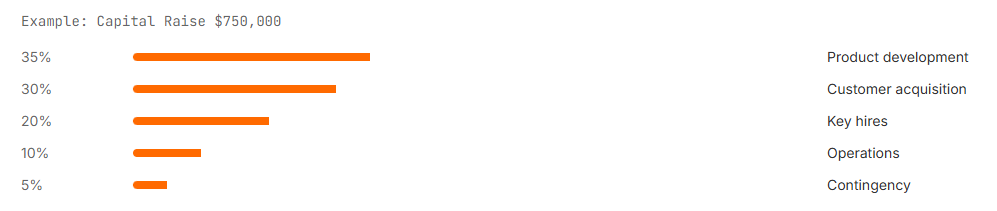
Capital should be tied to outcomes, not activity.
Funding Readiness Scorecard
Investor Narrative Worksheet
Financial Modeling: The Minimum Viable Model
This playbook is not a full financial advisory guide. However, if you are preparing to raise capital, you must operate from a financial model — even a simple one.
In the AI era, burn rates and capital efficiency can look dramatically different. Smaller teams can produce more output. Automation can reduce fixed costs. Your financial model should reflect the leverage tools you are actually using.
Revenue Inputs
- Target customer count
- Pricing per customer
- Monthly acquisition rate
- Conversion assumptions
- Churn (if recurring)
Cost Inputs
- Payroll
- Contractors
- Marketing spend
- Software/tools
- Rent/infrastructure
Example calculation:
100 customers × $500/month = $50,000 MRR
Raise Timing Guidance
Timing Guidance
Timing influences leverage.
1-2 months remaining → Reduced negotiating strength
6-9 months remaining → Improved leverage
Initiate fundraising while momentum exists — not urgency
Strong Signals Include
- Paying customers
- Recognized advisors
- Early partnerships
- Technical defensibility
- Documented financials
- Clear founder-market fit
When to Delay Fundraising
Delay if:
- CAC is unknown
- Milestone logic is unclear
- Use-of-funds plan is vague
- Demand remains unvalidated
- You are raising to “buy time”
Capital should accelerate structured progress.
If you want a structured second set of eyes before committing time to fundraising:
If you want a structured review of your runway, raise size, milestone plan, or financial model.
By the End of This Module
- Know your runway
- Understand personal runway implications
- Define a clear milestone
- Calculate raise size logically
- Build a minimum viable financial model
- Align readiness with funding type
- Recognize when to delay
Capital accelerates progress.
It requires operational discipline.
What Comes Next
Pitch Deck & Investor Materials
Once ready, you must communicate your opportunity clearly and convincingly.