
MODULE 1 — FOUNDER FIT & READINESS
Designing a business that fits you — before you build anything else
Key Questions This Module Answers
- What is founder fit vs founder readiness?
- How do constraints affect business design?
- How do I know what kind of business fits me?
Estimated reading time: 14 minutes
Difficulty level: Easy
Related module: Module 2 — Finding the Right Business to Build
MODULE OVERVIEW
Before you think about ideas, markets, funding, or growth, you need to understand yourself as a founder.
Founder fit is the degree to which a founder’s skills, constraints, risk tolerance, and execution capacity align with the business they are building.
This module exists to help you assess whether the business you’re designing actually fits who you are right now — not who you hope to be later, and not who someone else on the internet appears to be.
This is the foundation of the entire playbook. Every module that follows works better, faster, and with less friction when the business fits the founder.
If you skip this step, everything downstream becomes harder than it needs to be.
Why This Module Matters
In many cases the concept is sound but the operating demands do not match the founder’s capabilities.
When founder fit is ignored, it often leads to:
- burnout
- poor decision-making under pressure
- unnecessary financial risk
- inconsistent or stalled execution
Most of these problems compound overtime:
- chronic overwhelm
- constant pivoting
- loss of confidence
- progress that doesn’t compound
If you feel behind, scattered, or unsure what to focus on, that’s not a personal flaw. It’s usually a sign that alignment hasn’t been designed yet.
This module helps you slow things down before momentum turns into friction.
“This helped me realize I wasn’t behind — I was just building the wrong thing for how I actually work.”
– Rahman Ruston Co-Founder | IV20 Spirits
What Is Founder Fit and Founder Readiness?
Founder fit and founder readiness are related — but they are not the same thing.
Founder fit is about alignment.
Founder readiness is about execution capacity.
Two founders can pursue the same idea and get wildly different outcomes based on:
- clarity of intent
- realistic time and energy availability
- proximity to real customers
- access to leverage (tools, people, systems)
- financial and risk tolerance
Motivation matters.
Readiness determines speed, decision quality, and durability.
Alignment without readiness creates fantasy.
Readiness without alignment creates burnout.
This module focuses on both.
Founder Readiness: Can You Actually Execute This Right Now?
Founder readiness depends on whether your current circumstances support consistent execution.
The question is whether your situation allows sustained performance.
Honesty about your constraints matters more than ideal conditions.
Key dimensions of readiness include:
Time availability
How many real, sustainable hours per week can you commit for the next 6–12 months?
Financial runway
Personal and business. Financial pressure changes decision-making faster than most founders expect.
Cognitive bandwidth
Can you tolerate ambiguity, slow progress, and context switching without burning out?
Customer access
Can you reach real buyers directly — without permission, intermediaries, or unrealistic assumptions?
Execution leverage
Tools, systems, AI, partners, or processes that reduce brute-force effort.
Risk absorption
Financial, emotional, and reputational. Different businesses stress these in different ways.
You don’t need all of these to be strong — but misjudging them creates avoidable pain later.
This is where founder fit and founder readiness intersect.
Core Principles of Founder Fit
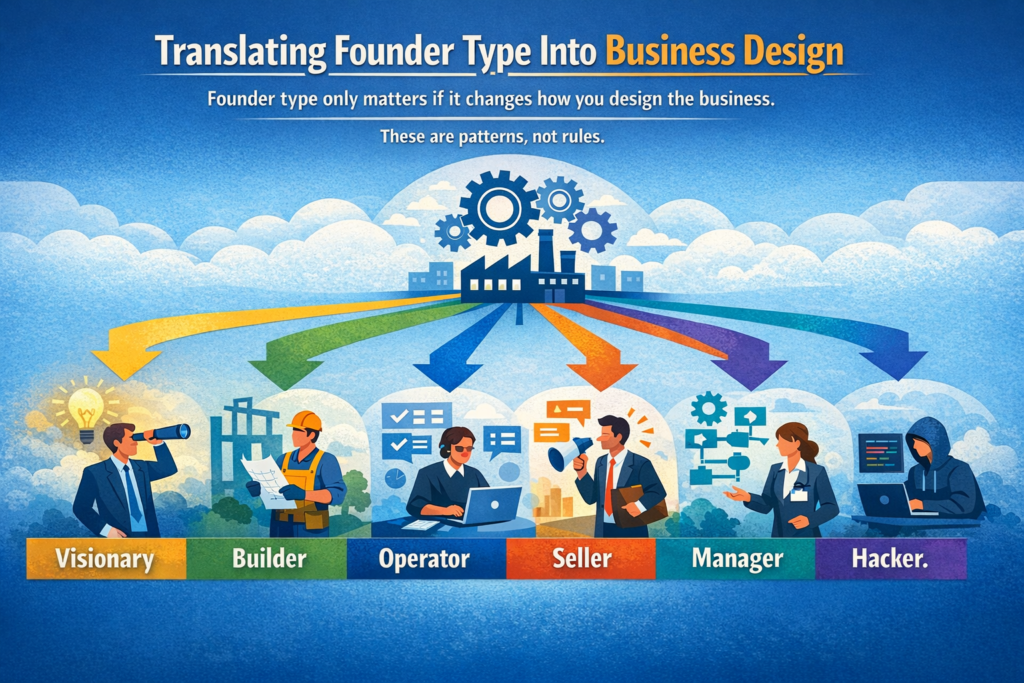
Understanding Your Founder Type
Most founders operate in one or two dominant modes.
Founder type shows where you are most effective.
Understanding your founder type helps you:
- choose business models more intelligently
- anticipate blind spots
- design teams and systems with intent
Most founders are combinations — but knowing your primary mode matters.
A Visionary:
Sees opportunities early, sets direction, shapes narrative.
Builder
Turns ideas into products, systems, and technical reality.
Operator
Creates consistency, process, and reliable execution.
Seller
Generates momentum through relationships and revenue.
Manager
Aligns people, priorities, and accountability.
Hacker
Leverages experimentation, automation, and constraints.
Visionary
Often fits: category creators, platforms, brand- or narrative-led businesses
Risk: ideas outpacing execution
Helpful cofounders: Operator or Builder
Builder
Often fits: SaaS, AI-enabled tools, technical products, scalable services
Risk: overbuilding before validation
Helpful cofounders: Seller or Visionary
Operator
Often fits: repeatable services, operationally complex models, roll-ups
Risk: optimizing too early or too locally
Helpful cofounders: Visionary or Seller
Seller
Often fits: services, B2B with complex sales, partnerships, communities
Risk: selling ahead of delivery
Helpful cofounders: Builder or Operator
Manager
Often fits: team-intensive and scaling organizations
Risk: underweighting product or demand creation
Helpful cofounders: Visionary or Seller
Hacker
Often fits: bootstrapped startups, automation-first models, niche tools
Risk: optimizing tactics without a durable strategy
Helpful cofounders: Visionary or Operator
Applying Founder Fit in Practice
Insight without application doesn’t change outcomes.
The Founder Fit Scorecard synthesizes the ideas in this module into a structured assessment you can use to ground future decisions.
It helps you evaluate:
- clarity and commitment
- realistic execution capacity
- customer proximity
- leverage and resource use
- risk and financial exposure
The goal isn’t to label yourself “ready” or “not ready.”
It’s to surface reality early — so later decisions are intentional, not reactive.
Personal KPI Priority Planner
Clarifies motivations, energy drivers, and non-negotiables.
Founder Type Survey
Understanding your founder type helps you build smarter teams and avoid common blind spots.
AI Powered Operators
Most founders don’t fail because of bad ideas.
They stall because execution breaks down.
We’re rolling out a suite of AI Powered Operators and advisory services designed to turn insight into action—fast.
Business Snapshot — IV20 Spirits
Insight:
Founder fit means building execution around complementary strengths.
Execution:
Creative vision was paired with operational leadership to manage compliance, manufacturing, distribution, and capital risk.
Outcome:
IV20 Spirits launched with discipline and focus, achieving placement in 250+ retail stores across three states.
Lesson:
Alignment between founder strengths and business demands reduces risk and accelerates execution.
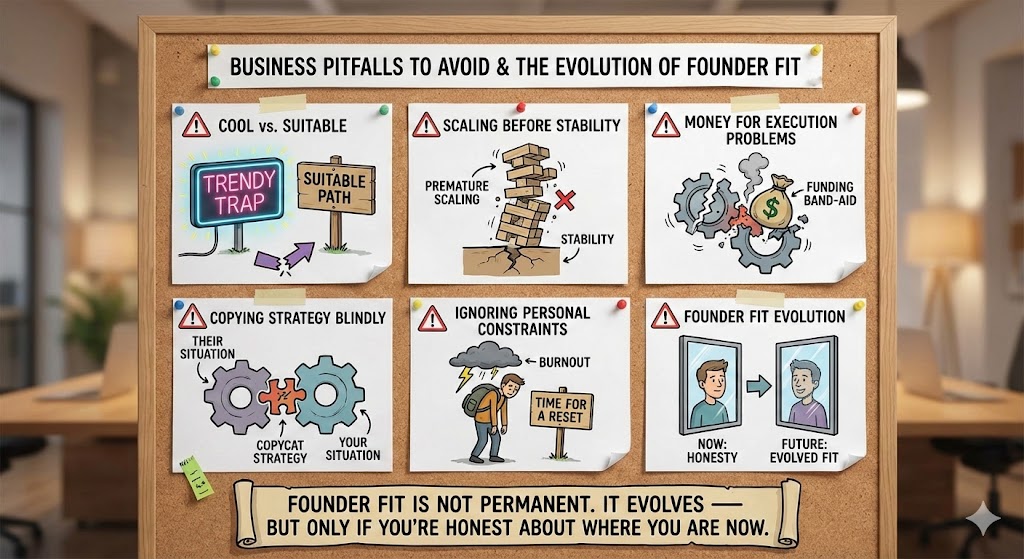
What to Ignore (Common Founder Traps)
Deliberately ignore:
- Comparison to other founders — you don’t know their runway or reality
- Overnight success narratives — most wins took years
- Pressure to scale too early — scale amplifies problems
- Business models that don’t fit your life — growth that burns you out isn’t durable
- Growth that burns you out is not durable.
Focus beats noise.
What Comes Next
What Comes Next
With founder fit established, the next step is choosing business models and execution paths that align with it.
The output of this module becomes the input for decisions around:
- business model selection
- go-to-market strategy
- systems and tooling
- where AI leverage actually makes sense
Key Takeaways
By the end of this module, you should know:
- what founder fit actually means
- how your constraints should shape what you build
- which founder modes you naturally operate in
- what types of businesses tend to fit those strengths
- where support or leverage matters most
You should feel less pressure to do everything and more confidence about where to focus next.