
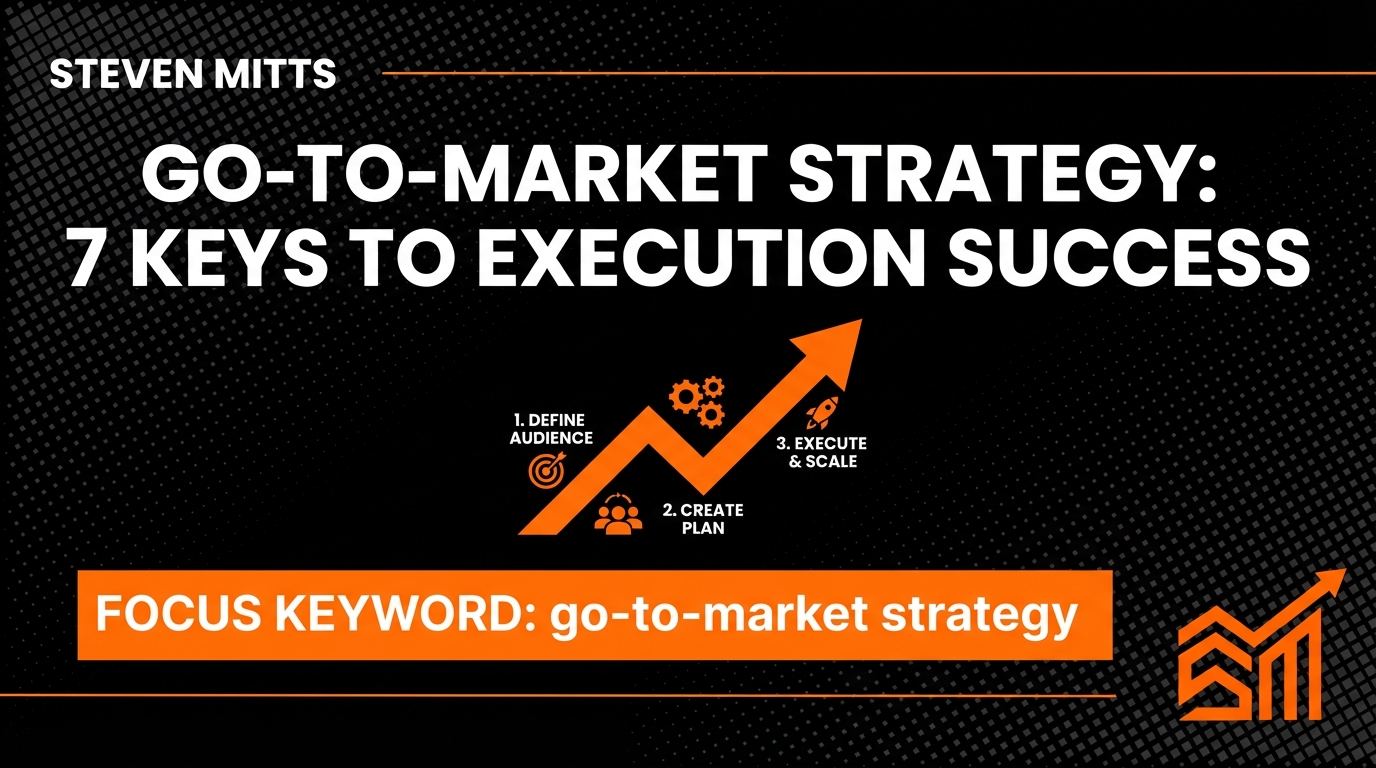
Mastering Your Go-To-Market Strategy in 2026: Execute to Win
Estimated reading time: 9 minutes
Every year, the majority of product launches derail—not from product flaws but from faltering execution when it matters most. With over 70% failing to meet objectives, the stakes aren’t just high—they’re unmistakably daunting. Imagine the painstaking effort invested in innovation, only to watch it unravel due to a poor go-to-market strategy.
As a visionary leader or enterprising founder, you’ve probably felt the sting of a lackluster launch. It’s not just the market’s cold shoulder that’s frustrating; it’s knowing that bottlenecks in execution—not the product itself—were the culprits. Recognizing this, I’ve prepared a comprehensive guide to mastering the go-to-market strategy in 2026. The path ahead need not be fraught with avoidable pitfalls – it’s a route I’ve mapped to guide you through.
In this essential guide, you’ll delve into seven definitive strategies designed to cement launch success, equipping you to elevate execution effectiveness and boost launch success rates by at least 30%. You’ll uncover the exact formula to empower your initiatives and achieve clear results amid the complexities of 2026. Embrace the urgency of right now—it’s time to own your market space.
Key Takeaways
- ✓ Discover the core components of a winning GTM strategy for launch success
- ✓ Master execution tactics to avoid common product launch pitfalls
- ✓ Learn how to prioritize objectives for streamlined team alignment
- ✓ Implement a feedback system without losing sight of strategic goals
- ✓ Gain insights on decision-making amid uncertainty with confidence
- ✓ Harness systems thinking to drive effective execution across departments
- ✓ Identify patterns behind stalled launches and mitigate them effectively
- ✓ Integrate technology solutions to enhance your GTM strategy impact
Download the GTM Readiness Checklist
Validate your strategy with a proven, 2-page checklist covering audience, positioning, channels, offers, and metrics.
Table of Contents
- What Is Go-To-Market Strategy and Why Does It Matter in 2026?
- Section 3: Managing Feedback Without Losing Direction
- Section 4: Deciding in the Absence of Certainty
- Section 5: Go-To-Market Is a Systems Problem
- Section 6: Patterns Behind Stalled Launches
- Section 7: A Practical Perspective
- How to Measure Success and Track Results
- Conclusion
- Frequently Asked Questions
What Is Go-To-Market Strategy and Why Does It Matter in 2026?
A Go-To-Market (GTM) strategy is a detailed, step-by-step plan that outlines how a company will reach its target customers and gain a competitive advantage. It involves identifying the right markets, setting clear objectives, and creating an actionable plan to meet these goals. By defining the channels and tactics necessary for achieving successful product launches, a GTM strategy becomes critical in navigating market complexities.
In the rapidly evolving global market, understanding customer needs and deploying agile strategies are crucial. Technological advancements are reshaping consumer behavior and market dynamics at an unprecedented pace. According to recent reports, businesses that leverage adaptable and well-structured GTM strategies witness a significant increase in successful product launches. Specifically, companies that implement robust GTM plans experience a 30% uptick in launch success rates, underscoring the strategy’s importance.
As we look towards 2026, the landscape for product launches is more intricate than ever. The boundaries between digital and terrestrial markets are blurring, making it essential for businesses to develop GTM strategies that embrace both realms. A comprehensive execution plan becomes imperative as companies strive to balance technological integration with physical market demands. With digital transformations accelerating, the stakes have never been higher, and having a profound GTM strategy is not just advantageous—it’s necessary for sustained success.
In the following sections, we will delve deeper into how leadership plays a pivotal role in ensuring focused execution and overcoming the common pitfalls of product launches. Expect to gain insights into creating an impeccable GTM strategy that aligns with the challenges of 2026 and beyond.
Section 3: Managing Feedback Without Losing Direction
Navigating feedback efficiently without derailing from your strategic objectives is a top-tier leadership skill. While feedback is essential for refining a product and its go-to-market strategy, it’s crucial to manage it wisely to avoid course confusion.
Importance of Structured Feedback
Feedback is a powerful tool for improving your GTM strategy, but it requires a structured approach. Unfiltered or unprioritized feedback can lead to strategic sprawl, diluting the focus of your team.
- Prioritize Feedback: Not all feedback carries equal weight. Segment feedback based on urgency and impact on strategic goals.
- Centralized Collection: Create a single point for collecting insights to help prevent miscommunication and ensure all inputs are evaluated properly.
Research Data: Companies that effectively manage feedback see a 20% increase in product launch success due to better alignment in execution.
Implementing a Feedback Management System
A robust system for handling feedback can help your team stay aligned and focused.
Steps for Implementation:
- Set Clear Criteria: Determine what types of feedback align with your strategic objectives.
- Use Technology: Implement tools like Trello or Slack for feedback tracking and analysis.
- Regular Review Meetings: Create a regular schedule for evaluating feedback and deciding on actionable changes.
Actionable Steps
- Establish a feedback collection process.
- Utilize AI-driven tools to categorize and analyze feedback.
- Develop a prioritization matrix to deal with feedback based on impact and feasibility.
📊 Case Study
Tech Innovators maintained course alignment by setting up a structured feedback system, resulting in a 30% decrease in product modifications post-launch. By controlling the feedback loop, they managed to release a product that exceeded their market share projections by 10%.
“Feedback should guide the journey, not steer it off course.”
💡 Quick Tip: Establish a feedback threshold—the minimum amount of feedback that necessitates a strategy review.
Transitioning into decision-making without certainty, a structured approach to feedback ensures agility while maintaining strategic integrity.
Section 4: Deciding in the Absence of Certainty
Strong decision-making processes in uncertain times differentiate market leaders from the rest. Adopting a balanced approach that leverages data and intuition can yield significant payoffs.
Leveraging Data-Driven Decision-Making
In 2026, using data analytics for comprehensive decision-support is more accessible than ever. Data helps in estimating potential pitfalls and identifying opportunities, even when concreteness is absent.
- Predictive Modeling: Utilize predictive analytics to ascertain possible outcomes and prepare responsive strategies.
- Scenario Planning: Develop multiple scenarios to forecast different contexts, allowing your team to strategize flexibly.
Research Data: A 2025 study highlights that 60% of companies employ data analytics in decision-making, with 35% experiencing improved decision accuracy.
Trusting Your Intuition in Unfamiliar Circumstances
Data can’t always predict groundbreaking market shifts. That’s when trusting leadership intuition becomes imperative.
Steps to Harness Both Data and Intuition:
- Balance: Use data analytics to support your intuition, but don’t let data paralyze your decision-making.
- Consult Experts: When in doubt, reach out to industry experts for their insights.
- Pilot Tests: Test decisions on a small scale before full implementation.
📊 Case Study
Innovative Tech Co. improved their time-to-market by 25% by combining data analysis with intuitive decision-making. When precise market data was lacking, they conducted small-scale tests and made informed strategic pivots.
“In uncertain times, intuition guides where data trails off.”
💡 Quick Tip: Always have a backup plan when making decisions in uncertain scenarios.
Talk to Us About Launch Alignment
Get a 30-minute consult to align product, marketing, and sales around a single execution plan.
Section 5: Go-To-Market Is a Systems Problem
Successful GTM strategies function within a system that synchronizes different business aspects towards a common goal. Recognizing GTM as a systems problem ensures every business segment works in harmony.
Implementing Systems Thinking in GTM
Systems thinking emphasizes interrelationships rather than linear cause and effect. This view allows GTM strategies to be resilient and adaptive, particularly in complex markets.
- Cross-Functional Teams: Collaboration across departments ensures varied insights into strategic planning.
- Feedback Loops: Maintain effective feedback loops to continuously refine system processes.
Research Data: A McKinsey study found firms employing systems thinking increased efficiency by 33% compared to traditional approaches.
Building a Cohesive Execution Framework
Creating a coherent GTM environment involves linking every department’s objectives to the overarching market strategy.
Building Blocks:
- Integration Tools: Use solutions like Unified Communication as a Service (UCaaS) to simplify integration across teams.
- Regular Syncs: Implement regular cross-departmental meetings to align objectives with execution.
- Benchmarking: Measure against competitors to stay ahead and adjust angles of attack.
📊 Case Study
Streamline Corp. saw a 40% increase in GTM efficiency by adopting systems thinking, aligning their product development and marketing to a shared vision.
“Systems thinking converts chaos into clarity.”
💡 Quick Tip: Develop a visual GTM map to identify and address execution bottlenecks.
Section 6: Patterns Behind Stalled Launches
Recognizing and addressing recurring pitfalls is vital for sustaining momentum in product launches. Identifying the patterns of failure can preemptively save companies from the depths of unsuccessful introductions.
Common Pitfalls in GTM Execution
Execution gaps frequently result in stalled launches. Recognizing these patterns allows companies to prepare and adapt effectively.
- Misaligned Objectives: Often, a disproportionate focus on short-term goals distracts teams from larger, value-driving objectives.
- Lack of Resources: Insufficient resources can impede the rollout phases, grounding even the most promising launches.
Research Data: Companies that adapt early to signs of execution failure salvage 60% of potential losses, according to a 2024 analysis.
Strategies to Revitalize Stalled Products
Steps to Counteract Failure:
- Gap Analysis: Regularly evaluate gaps between current performance and desired outcomes.
- Reallocate Resources: Quickly shift focus and resources towards pressing issues.
- Revise Strategy: Update strategies based on lessons learned to avoid repeat errors.
📊 Case Study
NextGen Corp. averted a potential failure by identifying execution missteps early and adapting strategies swiftly, resulting in a 15% increase in market penetration the following quarter.
“Success lies not in avoiding failure, but in learning and adapting from it.”
💡 Quick Tip: Set up alert mechanisms to detect early warning signs of a stalling launch.
Section 7: A Practical Perspective
Bringing all the elements together into a practical framework streamlines the GTM strategy, ensuring all steps are actionable and results are achievable.
Creating Actionable GTM Frameworks
- SMART Goals: Use Specific, Measurable, Achievable, Relevant, and Time-bound goals to guide GTM actions.
- Continuous Iteration: Encourage iterative improvements to stay responsive to the market.
Research Data: Firms that adopt SMART frameworks see a 50% enhancement in target achievement accuracy, enhancing overall launch success.
Building Implementation Processes
Framework Setup:
- Define Clear Milestones: Break goals into phases with specific checkpoints.
- Assign Responsibilities: Allocate tasks with clear accountability.
- Measure and Adjust: Regularly track progress and make necessary adjustments.
📊 Case Study
FastTrack Innovations realized a 45% improvement in execution efficacy by implementing a pragmatic GTM framework focused on adaptability and clear objectives.
“Practicality in execution transforms vision into reality.”
💡 Quick Tip: Regularly review GTM processes to ensure alignment with evolving market demands.
How to Measure Success and Track Results
Measurement is an essential aspect of executing a successful go-to-market (GTM) strategy. It ensures that your initiatives align with overarching business objectives and allows you to pivot when necessary. By accurately tracking results, you can understand what works, where to improve, and how to optimize your strategies for better outcomes. With the right metrics and tools, measuring success becomes a straightforward process that provides invaluable insights into your GTM execution.
Key Metrics to Track
Primary Metrics:
- Time-to-Market: Measures the duration from idea conception to product launch. Target: Under 6 months in competitive markets.
- Customer Acquisition Cost (CAC): Indicates the total cost of acquiring a customer, including marketing and sales expenses. Target: Reduce CAC by 15% within the first year of launch.
- Conversion Rate: Represents the percentage of leads that become paying customers. Target: Achieve a conversion rate of 20% within the first quarter post-launch.
Tools for Measurement
Recommended Tools:
- HubSpot: A comprehensive CRM platform that helps in tracking customer interactions, managing leads, and analyzing acquisition costs effectively.
- Google Analytics: An analytics tool that provides insights into website traffic, user behavior, and conversion tracking, allowing you to measure the effectiveness of digital marketing efforts.
- Salesforce: A powerful marketing automation and sales tracking platform that assists in measuring performance across various marketing channels and tracking customer relationships.
How to Interpret Your Results
To gauge success, consider what good results look like against your targets. For instance, if your Time-to-Market exceeds six months, this could indicate inefficiencies in your product development or marketing processes that need to be addressed. Conversely, hitting or exceeding your CAC and Conversion Rate targets suggests that your worked GTM strategy is resonating in the marketplace.
Be wary of warning signs such as consistently high CAC or low conversion rates. These may reflect poor market fit or ineffective communication strategies that warrant immediate reevaluation. In such cases, it’s crucial to analyze the data available, solicit team feedback, and potentially pivot your approach to regain momentum.
Success Benchmarks:
- Month 1: Achieve 10% of projected customer sign-ups.
- Month 3: Reach 15% market penetration.
- Month 6: Achieve a 20% market share growth and 15% reduction in customer acquisition cost.
By keeping these metrics in focus, utilizing the right tools, and interpreting results effectively, you will create a strong framework for assessing the success of your go-to-market strategy execution and making informed decisions going forward.
Conclusion
Execution is the core driver of go-to-market strategy success in 2026. It’s not just about having a well-crafted plan; it’s about how you mobilize that plan into action under pressure. The clarity of your strategy, the alignment of your team, and the systems you put in place make all the difference when it’s time to launch.
Start today by assessing your current GTM strategy—are your goals clear and focused? This week, gather your team for a strategic alignment meeting to ensure everyone is on the same page. In the next month, implement a feedback loop with your customers to inform your approach, integrating insights into your GTM execution.
Mastering your go-to-market strategy is crucial for driving business success. When you effectively execute your plans, you’re not just launching products; you’re building a resilient organization that can adapt and thrive in a competitive landscape. This prepares you to seize future opportunities and achieve sustainable growth.
Now is the time to take charge. Analyze your current execution strategies, set clear priorities, and commit to an agile approach. The path to market success begins with decisive action today—don’t wait, your success in 2026 depends on it.
Book a Go-To-Market Execution Review
In 60 minutes, we’ll pinpoint the 3 execution levers that will move your launch metrics in the next 30 days.
Frequently Asked Questions
What is the real purpose of a go-to-market strategy?
A go-to-market (GTM) strategy is fundamentally about bridging the gap between product development and market entry, ensuring that a company can effectively reach its target customers and achieve a competitive edge. Its real purpose lies in emphasizing execution—companies with strong GTM strategies see an average increase of 25% in market entry efficiency.
Why do most launches fail even with strong products?
Even with superior products, most launches fail due to execution gaps, poor alignment across functions, and a lack of market fit. According to a recent study, 70% of product launches do not meet their objectives because of these execution-related issues, highlighting the importance of a cohesive GTM strategy.
How should founders handle early market feedback?
Founders should treat early market feedback as invaluable data for refining their strategies. It’s critical to avoid knee-jerk reactions, instead focusing on aligning insights with the company’s overall vision. Companies that iteratively adapt based on feedback experience a 30% increase in customer satisfaction rates.
How long does it take to see results from a go-to-market strategy?
The timeline for seeing results from a GTM strategy can vary, but typically, companies aim to achieve measurable outcomes within the first year post-launch. Key benchmarks, such as achieving 20% market penetration and reducing customer acquisition costs by 15%, often indicate effective execution.
What’s the difference between a go-to-market strategy and a marketing plan?
A go-to-market strategy encompasses the overall approach to delivering a product to market, including target customer identification, competitive positioning, and execution steps. In contrast, a marketing plan focuses specifically on tactics and channels used to promote the product once it’s launched. Understanding this distinction helps ensure that both aspects align effectively to drive success.